Yunnan, China 5-12 Jun 2024

Updated: Jun 22, 2024

Kami, 20 orang yang dikumpulkan Fadilah Yunan, diketuai Shafiq Afandi, pendakwah gigih fasih berbahasa China n bnyk bahasa, bertolak dengan Airasia, sykt HTC
4 jam penerbangan. waktu sama mcm M,sia
RM1=1.54 Yuan
1 Yuan=0.65RM
Populasi lebih 8 juta org

Berdekatan hotel penginapan. Bas parking agak jauh bagi wargamas, puas mengheret beg
Sarapannya OK, kami ambil yg halal, pau kcg, kcg rebus, mihun sup sayur, telur rebus n goreng, air soya dll

Tour guide, Yong, berbahasa Inggeris
Cuaca keseluruhan Yunnan sederhana sejuk sepanjang tahun, nyaman macam ac
Merata2 tulisan China saja, elok download translation app. Kalau tak, nk tgk tv pun xle
Google, youtube, FB, wsp xde klu guna wifi ,perlu download beberapa VPN dr M,sia
Nasib dh roaming ,termurah RM49 seminggu Maxis

Masjid Yongning Kunming

The Stone Forest or Shilin (Chinese: 石林; pinyin: Shílín) is a notable set of limestone formations about 500 km2 located in Shilin Yi Autonomous County, Yunnan Province, People's Republic of China, near Shilin approximately 90 km (56 mi) from the provincial capital Kunming.
UNESCO World Heritage Sites as part of the South China Karst.[1
The Stone Forest area was a shallow sea some 270 million years ago. Extensive deposits of sandstone overlain by limestone accumulated in this basin during the Permian period of geologic time.


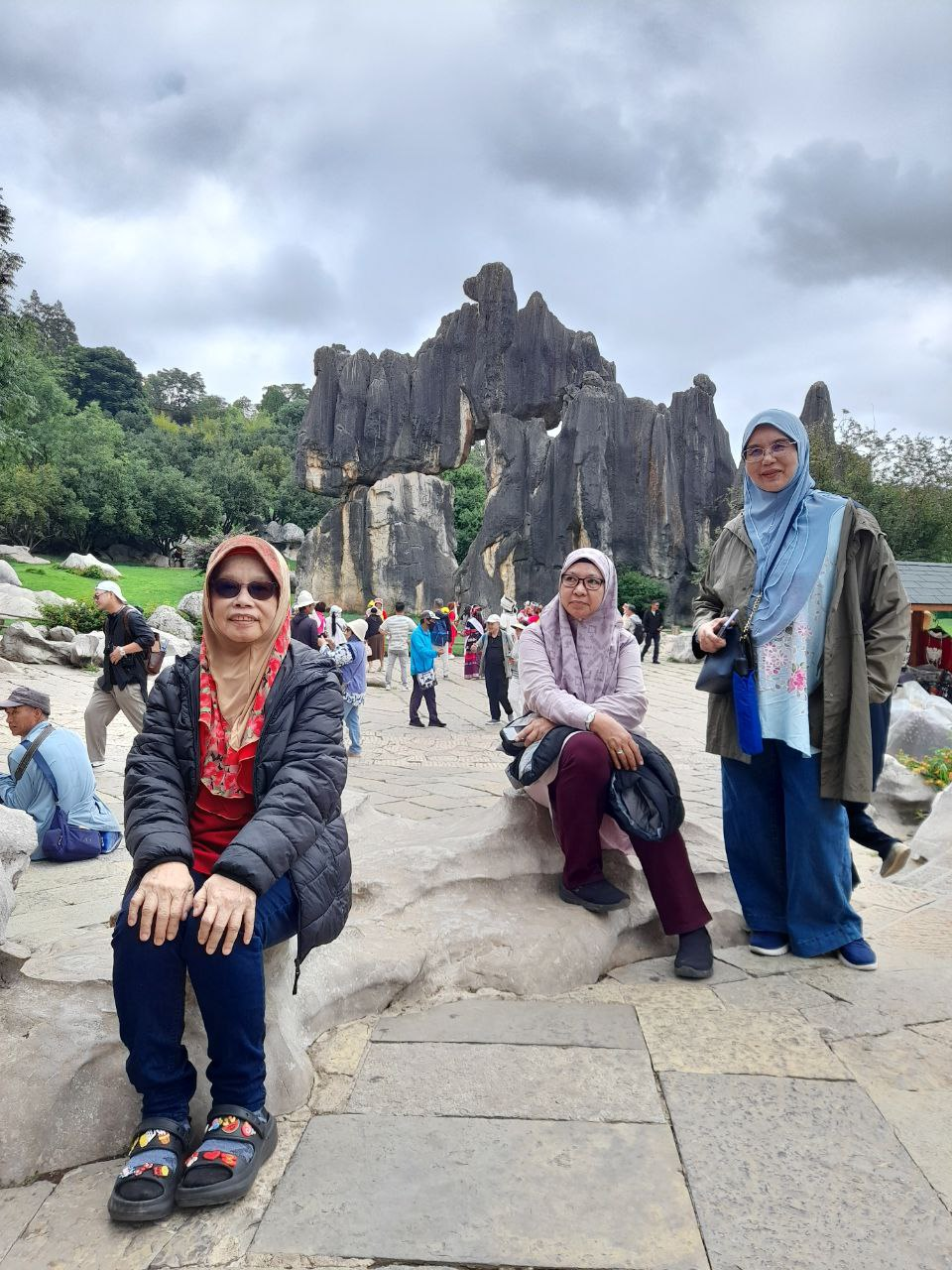


Model dr kumpulan kami

Dali City is located in western Yunnan, approximately 250 km (160 mi) northwest of the provincial capital of Kunming.

Salah 1 masjid di perkampungan Muslim, Old City


The Bai people first settled the region 3000 years ago.[3] Dali first emerged as the capital of the Nanzhao Kingdom in the 8th century


Erhai is situated at 1,972 metres (6,470 ft) above sea level. In size, the North-South length of the lake is 40 kilometres (25 mi) and the East-West width is roughly 7–8 kilometres (4.3–5.0 mi). Its area is 250 square kilometres (97 sq mi), making it the second largest highland lake in China, after Dianchi Lake

Geng yg kuat naik tangga ikut hotel ni boleh nampak tasik lebih umphh
Katanya, Santorini of China


Segala jenis haiwan digoreng, lipan, jengking, ulat2 dll

Bersama Dr Wahid, n drebar bas sepanjang kembara

Melawat kilang kain batik ikat


Ke kebun plum, manis, makan seberapa banyak
Kalau nak beli petik sendiri, 20Yuan=RM13/kg. Tak tahan lama, 2 hari dah mula bonyor

Makan kalau xpenuh semeja xsah

Keju goreng. ko ado?

Ala2 nasi ambeng pun ada
Shangri-La (Chinese: 香格里拉; pinyin: Xiānggélǐlā; Tibetan: སེམས་ཀྱི་ཉི་ཟླ།) is a county-level city in northwestern Yunnan province, China. It is the capital and largest city of Diqing Tibetan Autonomous Prefecture. It is bordered by the city of Lijiang to the south and Sichuan province to the northwest, north, and east.
The city was originally a county named Zhongdian (中甸县; Zhōngdiàn Xiàn); the Tibetan population referred to the area by its traditional name Gyalthang (Tibetan: རྒྱལ་ཐང་, Wylie: rgyal thang, ZYPY: Gyaitang), meaning "royal plains". On 17 December 2001, the Chinese government renamed the county "Shangri-La", after the fictional land of Shangri-La in the 1933 James Hilton novel Lost Horizon.


Yangtze or Yangzi (English: /ˈjæŋtsi/ or /ˈjɑːŋtsi/ simplified Chinese: 长江; traditional Chinese: 長江; pinyin: Cháng Jiāng; lit. 'long river') is the longest river in Eurasia, the third-longest in the world. It rises at Jari Hill in the Tanggula Mountains of the Tibetan Plateau and flows 6,300 km (3,915 mi) in a generally easterly direction to the East China Sea.[8] It is the fifth-largest primary river by discharge volume in the world. Its drainage basin comprises one-fifth of the land area of China, and is home to nearly one-third of the country's population.[9]

Ada lagi ropa2nya tandas dinding sekerat ni

Kebanyakan bangunan berwarna putih, sepesen

Kebun bunga berlatarbelakang gunung

Nak gambar atas jip, xterdaya lak nak panjat


Bersama Syafiq di pinggir tasik


Another mosque in Dali
Tiger Leaping Gorge (Chinese: 虎跳峡; pinyin: Hǔ tiào xiá) is a scenic canyon on the Jinsha River, a primary tributary of the upper Yangtze River. It is located 60 kilometres (37 mi) north of Lijiang City, Yunnan in southwestern China. It is part of the Three Parallel Rivers of Yunnan Protected Areas World Heritage Site.
At a maximum depth of approximately 3,790 meters (12,434 feet) from river to mountain peak, Tiger Leaping Gorge is one of the deepest and most spectacular river canyons in the world.[3] The inhabitants of the gorge are primarily the indigenous Nakhi people, who live in a handful of small hamlets. Their primary subsistence comes from grain production and nowadays hiking tourism.
Around 15 kilometres (9.3 mi) in length, the gorge is located where the river passes between the 5,596 metres (18,360 ft) Jade Dragon Snow Mountain and the 5,396 metres (17,703 ft) Haba Snow Mountain in a series of rapids under steep 2,000 metres (6,600 ft) cliffs.


turun dgn 3 escalator, 70Y@pp
Lijiang is famous for its UNESCO Heritage Site, the Old Town of Lijiang, which contains a mixture of different historical architecture styles and a complex, ancient water-supply system.[3]and borders Liangshan Yi Autonomous Prefecture and Panzhihua City in Sichuan Province to the east.
The Nakhi or Nashi (simplified Chinese: 纳西族; traditional Chinese: 納西族; pinyin: Nàxī zú; Naxi: Naqxi) are a people inhabiting the Hengduan Mountains abutting the Eastern Himalayas in the northwestern part of Yunnan Province, as well as the southwestern part of Sichuan Province in China.[1]

Tulisan Nashi dolu2, suku kaum tour guide kami

Naik cable car baru mampu sampai
Jade Dragon Snow Mountain is an enormous mountain with an elevation of 18,360 feet (5,596 m)
There is a cable car that takes visitors to an observation platform sitting at 14,783 feet (4,506 m) with stunning views of the mountain. The more adventurous can continue hiking up to a second observation area at 15,350 (4,680 m) which provides better glimpses of the snowy summit.


Kena bawa oksigen, kalau tak mcm nk semput dgn Lailah yg memperkenalkan kumpulan ini

sampai bawah, ke Blue Moon Valley. Sebelah kanan Lailah, Adibah kawan sekolah n housemate mula2 kerja


cultural show lak
ADayan (Chinese: 大研), commonly called the Old Town of Lijiang (simplified Chinese: 丽江古城; traditional Chinese: 麗江古城) is the historical center of Lijiang City, in Yunnan, China. It is a UNESCO World Heritage Site.
s The town has a history going back more than 1,000 years and was once a confluence for trade along the "Old Tea Horse Caravan Trail". The Dayan Old town is famous for its orderly system of waterways and bridges,


Kedai teh. Yg popular teh pu erh
Puerh tea is made from a larger leaf strain of camellia sinensis called Dayeh, which are ancient trees with mature leaves that are said to be between 500 and 1000 years old.
Pu-erh tea can be traced back to the Yunnan Province during the Eastern Han Dynasty (25-220CE).


ada wargamas menari senam

Hari akhir kami ke Lashihai Wetland Park
Lashihai Wetland is a system of freshwater lakes and wetlands in Yunnan Province of south-central China. It is located in the Hengduan Mountains between 2,440 and 3,100 meters elevation. It includes Lashihai lake and its surrounding wetlands, as well as Wenhai lake to the north and Jizi Reservoir to the south. The wetlands drain into the Jinsha River, an upper basin tributary of the Yangtze
The wetlands are important habitat for resident and migratory waterbirds. More than 100,000 waterbirds visit each year, and use the lake as a migratory stop-over, breeding ground, and/or wintering habitat


Another Old City yg agak tenang n mahal

kedai jade

Balik ke Kunming dgn k-api laju 3 jam
TQVM kawan2 semua esp Fadilah n Syafiq
Maaf zahir batin
4880
As the largest and best-preserved Tibetan residence groups in China, it is over thirteen hundred years old, which not only plays an important role in the Old Tea - Horse Road, but also serves as a corridor connecting Chinese and Tibetan language, people, religion and cultures. the largest and best-preserved Tibetan residence groups in China, it is over thirteen hundred years old, which not only plays an important role in the Old Tea - Horse Road, but also serves as a corridor connecting Chinese and Tibetan language, people, religion and cultures.


Comments